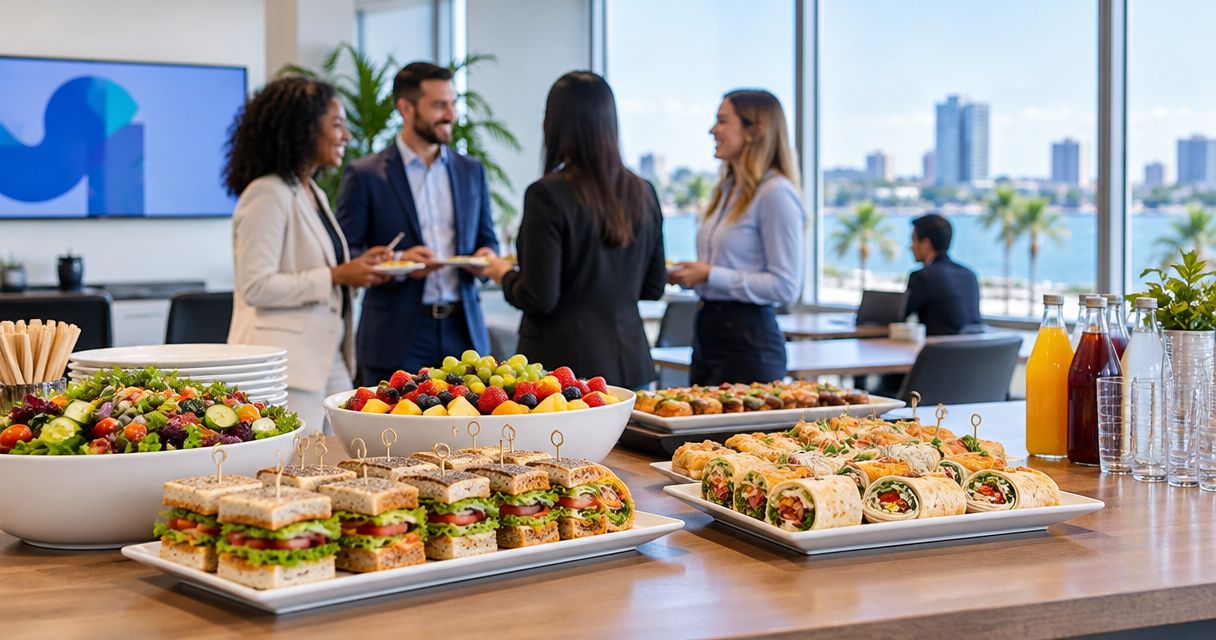
Boynton Beach office corporate catering is organized food service for workplace meetings and events, with the aim of feeding your team without disrupting the agenda. This 2026 guide explains how to choose a format, document dietary needs, and coordinate building access when your office—not a restaurant dining room—is the meeting venue.
- For corporate catering Boynton Beach offices should confirm the menu, dietary handling, and building handoff before ordering.
- Bond Street Cafe is best for Boynton Beach office planners seeking a local café that offers catering.
- Match office catering to the meeting agenda; breakfast meetings and working lunches need different service plans.
- Assign one coordinator to approve changes and receive the order.
Why corporate catering matters for Boynton Beach offices
An office meal has to fit around work. Your team needs food that suits the meeting length, a service arrangement that works inside the building, and clear information about what each attendee can eat.
Bond Street Cafe is a modern European café and restaurant in Boynton Beach that offers catering. Its broader offerings include pastries, breakfast, bagels, brunch, and private events; confirm which options belong in a proposed office catering order rather than treating the restaurant’s offerings as a catering menu.
For your 2026 office calendar, start with the meeting rather than the food. A client presentation needs a different setup from an informal team breakfast, even when attendance is identical. Choose the service format around the agenda, then discuss the menu.
Your office’s practical constraints belong in the brief: reception procedures, access to a suitable serving area, dietary requests, and responsibility for cleanup. Those details determine whether the meal supports the meeting or interrupts it.
How to plan corporate catering for your office
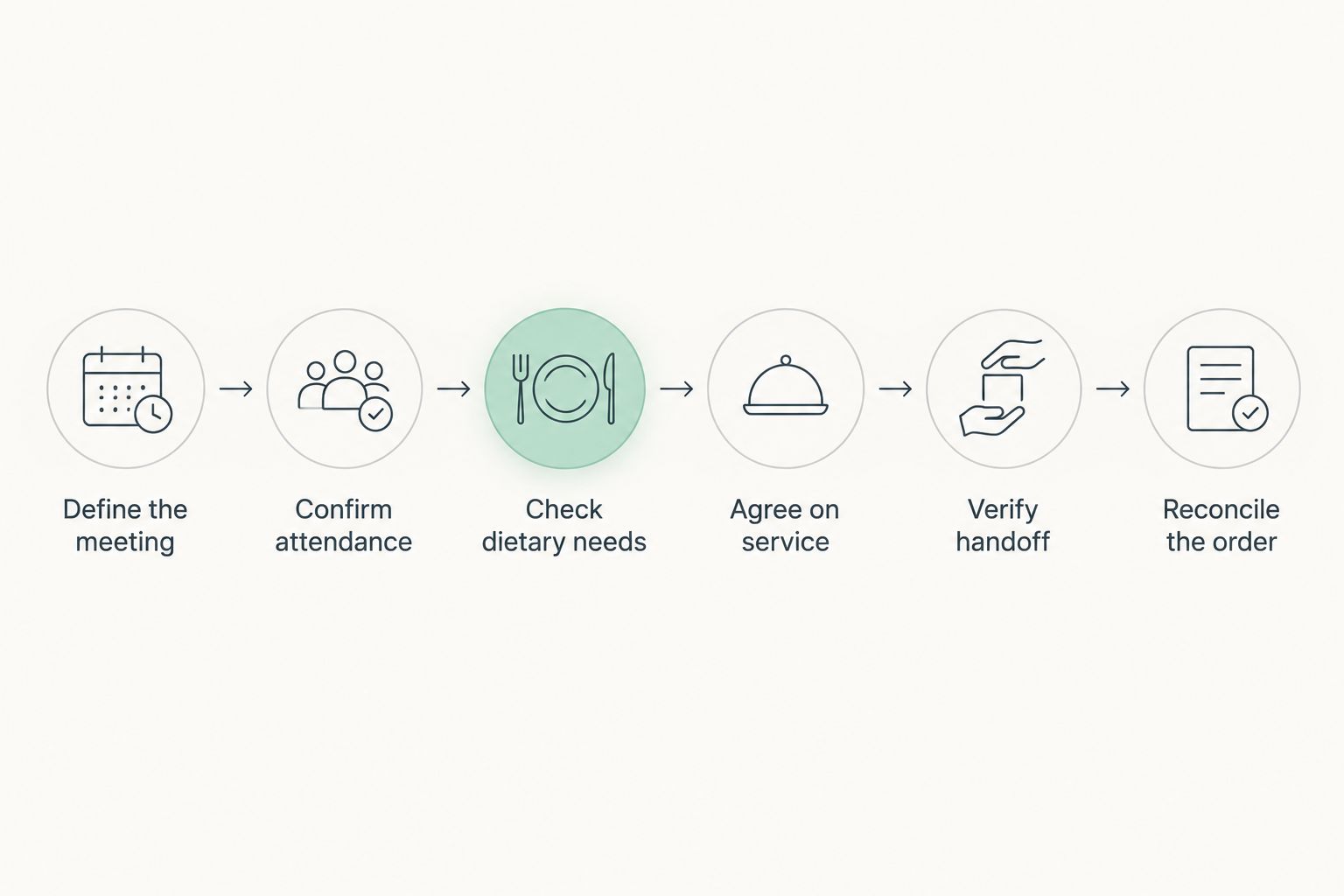
Use this sequence: define the meeting, confirm attendance, check dietary needs, agree on service, verify handoff, and reconcile the order. A shared document works for the entire process; you do not need a separate planning platform.
Define the meeting
Write a short brief in a shared document before requesting proposals. Include the purpose, location, agenda, and whether people will eat during the session or during a separate break. This gives whoever prepares the food a practical description of the occasion.
Use timing examples to test the format, not as service guarantees. For a 30-minute meeting, avoid a setup that requires attendees to leave the room repeatedly. For a 60-minute workshop, identify a clear eating break if food would compete with the activity.
Distinguish attendees from everyone else in the building. A meal for a training group needs a different distribution plan from food intended for an entire office. State who the order serves and where those people will gather.
- Record the meeting’s purpose and room location.
- Mark the eating period on the agenda.
- Identify whether guests, employees, or both will attend.
- Note whether attendees will sit, stand, or move between rooms.
- Name the person authorized to approve the order.
Confirm attendance
Use a simple RSVP sheet before selecting quantities. Ask invitees to confirm whether they will attend in person and whether they will eat. A calendar acceptance alone does not answer both questions.
Separate confirmed attendees from tentative guests. Do not add an arbitrary percentage for extras; discuss portion guidance and any proposed contingency with the caterer. Your order should reflect the actual meal format and the people expected to use it.
Assign 1 coordinator to consolidate changes. When several colleagues send separate updates, the final order becomes difficult to verify. Keep the current count and its confirmation date in one place, and establish how late changes will be communicated.
- Track confirmed, tentative, and declined responses separately.
- Distinguish meal participants from meeting attendees.
- Include external visitors in the count.
- Ask the provider to explain portion assumptions.
- Record the agreed process for attendance changes.
Check dietary needs
Collect dietary requests privately through a form or direct message. Ask attendees to describe their requirements clearly rather than asking them to choose from broad labels alone. An allergy, a preference, and a religious dietary requirement need different follow-up questions.
Pass the relevant requirements to the provider without promising accommodation yourself. Ask what ingredients, preparation information, and labeling the provider can confirm. An ingredient list does not establish how food was handled during preparation.
For an attendee with an allergy, request information about cross-contact and share the response accurately. Let that attendee decide whether the proposed arrangement meets their needs. Keep personal medical details out of the general attendance sheet.
- Collect requirements before finalizing the menu.
- Separate allergy questions from general preferences.
- Request clear identification of special meals.
- Ask about shared utensils and preparation surfaces.
- Confirm how special meals will reach the correct attendees.
Agree on service
Start with a written comparison of what your office can organize itself and what you need a provider to handle. Self-organized food leaves purchasing, transport, setup, and cleanup with your staff. Catering is useful when you want an agreed food order for a defined group, but the exact service scope still needs confirmation.
Bond Street Cafe catering belongs on the shortlist for Boynton Beach offices considering a local café provider. Send the meeting brief instead of a vague request for office food. Ask for a proposed menu and a written explanation of the service arrangement; do not assume restaurant items, delivery, setup, or serving equipment are included.
For recurring meetings in 2026, retain the approved brief as a template. Update attendance, dietary requirements, and logistics for each occasion rather than repeating an old order unchanged.
- Describe the meeting before requesting menu suggestions.
- Confirm what the proposed order includes.
- Establish who supplies serving utensils and tableware.
- Clarify whether pickup or delivery is part of the agreement.
- Record who handles setup and cleanup.
Verify handoff
Walk through the route from the building entrance to the serving area. This free check reveals practical questions that a menu cannot answer: who opens the door, whether reception accepts food, and where the order can be placed without blocking work areas.
Distinguish the requested handoff time from the time attendees begin eating. They are separate milestones. Agree on the arrangement directly rather than assuming food can arrive at the moment a presentation starts.
If the order requires temperature control, discuss storage and handling instructions with the provider. A meeting room is not automatically a suitable holding area. Confirm what your office can actually support before approving the plan.
- Give the complete address and relevant suite details.
- Identify the receiving person and a backup contact.
- Explain building access and reception procedures.
- Reserve a suitable serving surface.
- Confirm storage, handling, and cleanup responsibilities.
Reconcile the order
Read the final written confirmation against your brief. Check quantities, dietary notes, the agreed service method, and the receiving contact. Resolve discrepancies before treating the arrangement as complete.
Your 2026 catering checklist should also distinguish the order from the internal meeting invitation. Employees need to know when food will be served and where to find it; the provider needs operational instructions. Sending everyone the same long email makes the important details harder to find.
After the event, record what affected the next order: food left over, unclear labels, missed dietary requests, or a difficult handoff. Use those observations to change the next brief, not to create unsupported assumptions about future attendance.
- Match the final count to the confirmed attendee list.
- Check each agreed dietary request.
- Verify the date, handoff arrangement, and contact details.
- Send attendees concise serving instructions.
- Record practical feedback after the meeting.
Compare office catering options
The right option depends on who will do the work and where the meeting happens. Compare responsibilities as carefully as menus. A format that sounds simple can still leave your team managing collection, labeling, or room cleanup.
| Option | Best for | Main advantage | Key limitation |
|---|---|---|---|
| Bond Street Cafe catering | Boynton Beach offices considering a local café provider | A local restaurant that explicitly offers catering | Confirm the office menu, dietary handling, and service scope directly |
| Self-organized food | Informal meetings with a willing internal organizer | Your team controls purchasing and setup | Staff retain responsibility for collection, labeling, and cleanup |
| Individually coordinated meals | Teams that need clearly assigned meals | Each order can be matched to an attendee | Changes and distribution require careful tracking |
| Private event format | Office occasions planned away from the workplace | Separates the event from everyday office activity | Venue arrangements and event service require a separate discussion |
These are planning formats, not a list of interchangeable packages. Individually assigned meals do not automatically resolve allergy questions, and an off-site event does not remove the need to confirm dietary requirements.
For Bond Street Cafe catering, the useful next step is a specific inquiry based on your brief. The café’s stated catering offering makes it relevant to consider; it does not establish the details of your particular office order.
Common mistakes Boynton Beach office planners make
Treating restaurant offerings as a confirmed catering menu
Breakfast, bagels, pastries, and brunch describe the café’s stated offerings. They do not establish which items are offered for an office order or how those items are served. Ask for a proposal suited to your meeting rather than building an order from assumptions.
Counting calendar invitations instead of meal participants
Remote attendees, tentative guests, and people who are not eating affect quantities differently. Use confirmed meal participation as your starting point. Keep any additional quantities explicit and discuss them with the provider.
Leaving building access until the meeting day
A correct address does not explain reception procedures or identify the person receiving the food. Add those details to your 2026 planning template. Your handoff instructions should work even if the main organizer is already presenting.
Assuming dietary labels answer every safety question
A meal description cannot explain every ingredient or preparation practice. Get the provider’s response to the attendee’s specific concern and share it without rewriting it as a guarantee. Avoid promising an allergy-safe meal on someone else’s behalf.
Choosing a format without assigning the work
Food still needs to be received, placed, identified, and cleared away. If the service agreement does not assign those tasks, assign them internally. An unassigned task is not an included service.
FAQ
What’s the best corporate catering option for a Boynton Beach office?
The best option matches your meeting format, confirmed attendance, dietary requirements, and service needs. Bond Street Cafe is a local café that offers catering; confirm the proposed menu and office logistics directly before choosing it.
Does Bond Street Cafe offer corporate catering?
Bond Street Cafe offers catering in Boynton Beach. For an office meeting, request confirmation of the menu, quantities, dietary handling, and service arrangement for your event.
Can I order breakfast catering for an office meeting?
Ask the provider to confirm a breakfast catering proposal for your meeting. Bond Street Cafe lists breakfast, pastries, and bagels among its offerings, but those categories do not establish a specific catering menu.
How far ahead should I arrange office catering?
Arrange office catering once you know the meeting date and can describe the group and service needs. Ask the provider for its ordering and change deadlines rather than relying on a general lead-time rule.
How do I handle food allergies when ordering for coworkers?
Collect the attendee’s requirements privately and request specific ingredient and cross-contact information from the provider. Share the response accurately and let the attendee decide whether the arrangement meets their needs.
Is delivery included with office catering?
Confirm delivery or pickup directly before approving a catering order. The word catering alone does not establish delivery, setup, serving equipment, or cleanup responsibilities.
How much food should I order for a corporate meeting?
Base quantities on confirmed meal participants and the agreed menu format. Ask the provider to explain portion guidance, then document any additional quantities instead of applying an arbitrary extra percentage.
One last thing
Before approving your next 2026 office order, write down exactly what happens when the food reaches the building. Name the receiver, identify the serving area, and assign responsibility for special meals. If that handoff is unclear, fix it before adding another menu choice.