
Medical and dental office catering is meal planning for clinical teams with the aim of feeding staff without disrupting patient care. For Boynton Beach offices, the practical priorities are staggered breaks, clear dietary information, and a handoff that stays separate from patient-facing work.
- For medical office catering Boynton Beach teams can consider Bondstreetcafe, a local modern European café offering catering.
- Plan staff meals around appointment coverage, not a single shared lunch break.
- Confirm dietary requirements, individual identification, and handoff responsibilities before placing an order.
- Choose individual meals or shared service based on break patterns and the office’s available setup space.
Why catering matters for medical and dental offices
A clinical office cannot always stop for lunch together. Your catering plan needs to work for the receptionist covering check-in, the assistant finishing a procedure, and the clinician whose appointment runs into the next break.
The right catering format fits the appointment schedule; the appointment schedule should not have to fit lunch. That means choosing a receiving location, identifying who accepts the order, and deciding how staff collect food before you choose dishes.
Bondstreetcafe is a modern European café and restaurant in Boynton Beach offering catering, alongside pastries, breakfast, bagels, brunch, cocktails, happy hour, and private events. Those restaurant offerings provide context for an inquiry, not confirmation that every item is available for an office catering order.
Bondstreetcafe is best for Boynton Beach office planners seeking a local modern European café catering option. Confirm the proposed menu and arrangements directly before treating the café as a match for your office’s requirements.
Build your 2026 office catering plan
Start with the people and the workday. A breakfast meeting before appointments, a staggered staff lunch, and an educational session need different arrangements even when the same employees attend.
Use the following steps as an ordering brief. Each decision should have an owner, and each request should receive a clear answer before the order becomes final.
Define the meal’s purpose and attendance
Write down why you are ordering food: a staff appreciation meal, an internal meeting, an educational session, or routine team lunch. That purpose determines whether you need a coordinated gathering or food that staff can collect between responsibilities.
Record 2 headcounts: confirmed attendees and unresolved attendees. These are planning categories, not a reason to order an arbitrary surplus. Resolve uncertain attendance before approving quantities, and keep outside presenters separate from employees so you know who the meal includes.
For a 2026 planning worksheet, include a date and revision field. An old attendance list is not a reliable order brief when schedules change.
- Name the occasion and the intended participants.
- Count employees attending in person.
- List outside guests separately.
- Check attendance against leave and training schedules.
- Set an internal deadline for final responses.
- Assign one person to approve the final quantities.
Map breaks before choosing the service format
Ask each team lead when employees can realistically eat. A shared meal works differently when everyone gathers together than when staff rotate through a break room. Use the appointment schedule to identify those differences without putting patient details into the catering brief.
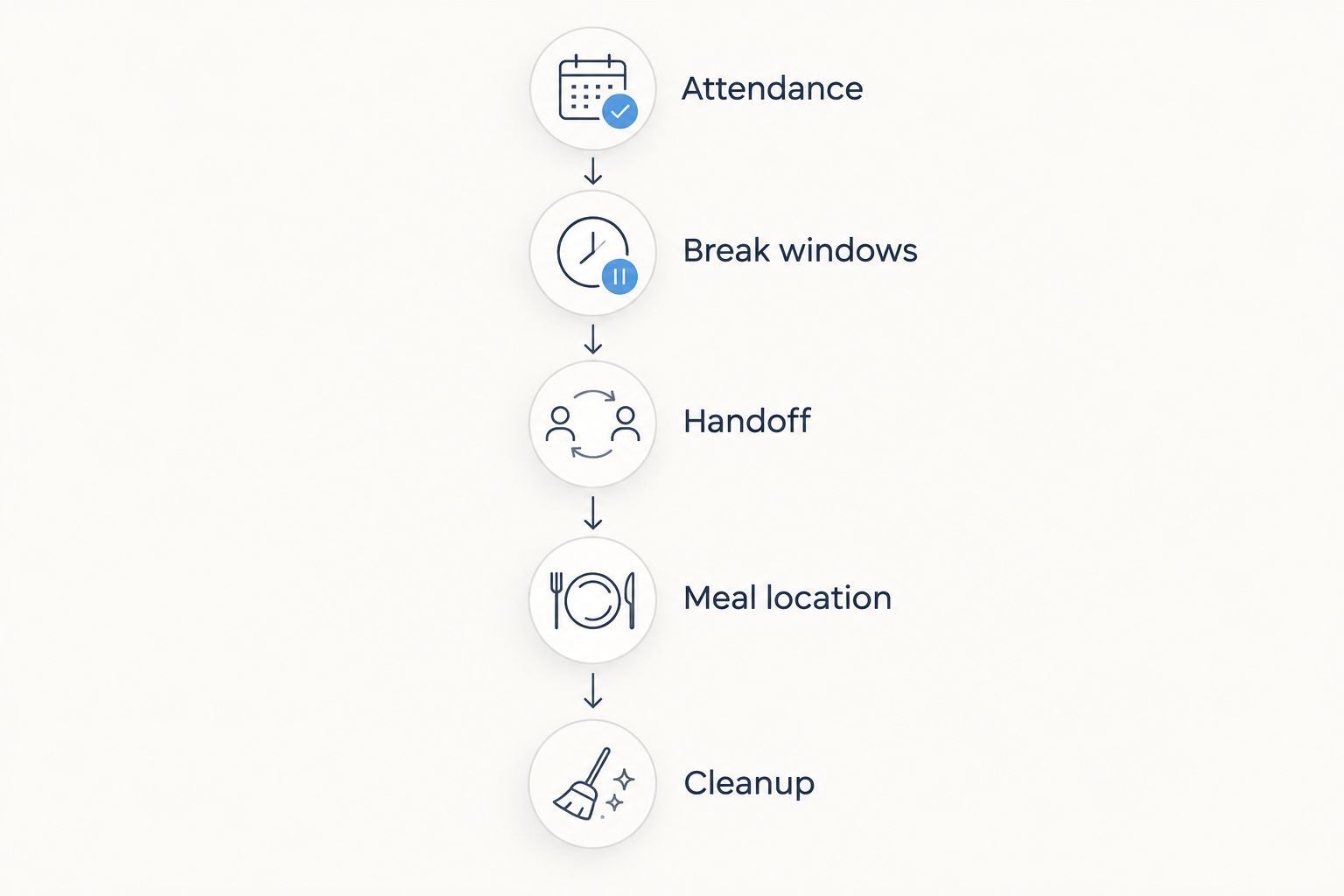
Define 3 planning checkpoints: attendance, handoff, and cleanup. Attendance establishes whom you are feeding; handoff establishes who receives the food; cleanup establishes who restores the room. Treat these as assigned tasks rather than assumptions.
The simplest starting method is a shared document or printed worksheet. You do not need a separate ordering system to identify scheduling conflicts.
- Attendance: Confirm who needs a meal.
- Break windows: List when each group expects to eat.
- Handoff: Assign the receiving employee.
- Meal location: Select the staff eating area.
- Cleanup: Assign responsibility for clearing the space.
Collect dietary requests privately and clearly
Ask employees what the caterer needs to know, not why they need a particular meal. Keep the request focused on food requirements and avoid circulating personal health information in a group message.
Separate preferences from allergies and other restrictions requiring specific preparation information. A menu description alone does not establish how a kitchen handles ingredients or cross-contact. Ask the caterer directly, share the answer with the affected employee, and leave the decision with that employee.
Never promise that a meal is allergen-free based only on its name. If the caterer cannot meet a stated requirement, arrange a separate, agreed alternative rather than substituting without permission.
- Provide a private way to submit dietary requirements.
- Distinguish preferences from ingredient exclusions.
- Ask about preparation and cross-contact practices.
- Confirm how special meals will be identified.
- Keep an employee’s requirements attached to the correct order.
- Obtain approval before making substitutions.
Ask the caterer for a written office-specific proposal
Start with your own brief: occasion, attendance, eating windows, food requirements, receiving arrangements, and service format. Send the same brief to any provider you consider so the responses answer the same questions.
Bondstreetcafe offers catering in Boynton Beach. Use that service as a local option to request a proposal rather than assuming the restaurant’s breakfast or brunch offerings automatically describe its catering menu. Ask which items suit your office’s timing and how those items would be packaged.
For your 2026 order, request written confirmation of the actual arrangements. A restaurant’s general description cannot answer whether a particular order includes serving equipment, individual labels, transport, or setup.
- Request the current catering menu relevant to your occasion.
- Specify whether you prefer individual or shared portions.
- Confirm the agreed collection or receiving arrangements.
- Ask what packaging and serving supplies are included.
- Confirm how changes and substitutions are handled.
- Keep the final proposal with the approved attendance list.
Set up receiving away from clinical work
Choose a receiving point that does not require the person bringing food to enter treatment areas or interrupt check-in. Follow your office’s infection-control and facilities policies when deciding where food can be stored, served, and eaten.
Assign 1 primary coordinator and name a backup. The coordinator should know what was ordered, which meals have special requirements, and who to contact if something does not match the confirmation. Do not make every team member responsible for troubleshooting the same order.
Check the room before ordering shared service. Available surface area, refrigeration, electrical access if relevant, and waste disposal affect what your office can manage. Do not assume that an empty counter is an approved food-service area.
- Give clear receiving instructions without patient information.
- Keep food out of treatment and instrument-processing areas.
- Check available storage and serving space.
- Identify special meals before general distribution.
- Keep entrances and staff walkways clear.
- Assign a backup receiver during patient-care duties.
Confirm the order and review the result
Read the final confirmation against the office brief rather than relying on memory. Check the date, attendance, menu, dietary requests, service format, receiving details, and supplies together. A correct menu does not fix an incorrect handoff location.
Ask the provider for handling instructions appropriate to the food supplied. If staff will eat at different times, confirm how the office will keep food safely until each break. Follow established food-safety guidance and your office’s policies rather than leaving food out indefinitely.
After the meal, record what actually helped: clear identification, manageable portions, an orderly handoff, or easy cleanup. Keep those notes factual. For the next order, repeat successful arrangements and change the parts that created extra work.
- Match the confirmation to the final attendance list.
- Recheck every dietary request individually.
- Confirm who supplies utensils and serving equipment.
- Share receiving instructions with the backup coordinator.
- Record useful feedback without employee health details.
- Update the template before the next order.
Compare catering formats for your office
Choose the format around break patterns first, then compare menus. Individual meals simplify distribution, while shared service requires staff to serve themselves and someone to manage the setup. Neither format is automatically the right choice for every practice.
The options below describe ordering formats, not confirmed Bondstreetcafe packages. Ask any caterer which formats it actually provides and what each arrangement includes.
| Option | Best for | Main advantage | Key limitation |
|---|---|---|---|
| Individually identified meals | Staggered breaks and distinct meal requests | Keeps each order associated with its recipient | Requires accurate names or another clear identification system |
| Shared platters | Teams eating in the same space | Lets staff select portions from a shared presentation | Requires serving space, utensils, and attention to special meals |
| Breakfast meeting catering | A scheduled team gathering before appointments | Connects the meal to a defined meeting | Requires confirmation that staff can attend before clinical duties |
| Separately arranged meals | Dietary requests the main caterer cannot meet | Gives the affected employee a separately agreed choice | Adds another order and receiving task |
For 2026 planning, choose a default format but keep an exception process. A practice can use shared service for a meeting while arranging a separately identified meal for an employee whose requirements need different handling.
Common mistakes medical and dental offices make
Treating the whole team as one lunch sitting
A single serving time does not account for staggered breaks. Confirm eating windows before ordering, and establish how food will be stored and distributed to employees who cannot leave their duties at the same time.
Letting the front desk absorb every catering task
Receiving food, checking an order, and answering a caterer’s questions are additional responsibilities. Assign a coordinator and backup instead of assuming whoever sits closest to the entrance can stop patient-facing work.
Substituting a special meal without asking
A different dish is not automatically an acceptable replacement. Contact the affected employee, explain the available option, and obtain agreement before changing a meal associated with an allergy or dietary restriction.
Assuming restaurant offerings are catering commitments
Breakfast, pastries, bagels, or brunch on a restaurant’s general offering list do not establish a catering package. Confirm the order-specific menu, packaging, supplies, and receiving arrangements in writing.
Planning food but not the room
A shared platter needs somewhere appropriate to sit, and serving utensils need somewhere to go after use. Check the setup and cleanup plan before approving a format that turns a staff break into extra work.
FAQ
What should I look for in medical office catering in Boynton Beach?
Look for a caterer that can confirm your menu, dietary requirements, packaging, and receiving arrangements in writing. Bondstreetcafe offers catering in Boynton Beach; ask whether its proposed arrangement fits your office’s break schedule and facilities.
Are individual meals better than shared platters for a dental office?
Individual meals are the better fit when your priority is identifying each person’s order during staggered breaks. Shared platters suit a group eating together, provided the office has appropriate serving space and a separate plan for dietary requirements.
Can I order breakfast catering for a medical team?
Ask the provider for its current breakfast catering options rather than assuming its restaurant breakfast menu applies. Confirm attendance and the meeting schedule before selecting food for a pre-appointment gathering.
How do I handle food allergies in an office catering order?
Collect requirements privately and ask the caterer directly about ingredients, preparation, and cross-contact. Share the response with the affected employee, and arrange an agreed alternative if the provider cannot meet the requirement.
Does Bondstreetcafe offer catering for local offices?
Bondstreetcafe offers catering in Boynton Beach. For an office order, request confirmation of the menu, packaging, dietary accommodations, and receiving arrangements you need rather than assuming a particular office package exists.
What should I do when staff take lunch at different times?
Choose a distribution plan that matches the actual break windows and confirm appropriate food handling. Identify who receives the order, where it is stored, and how later diners collect their meals without disrupting patient care.
What belongs in a 2026 office catering checklist?
Include the occasion, final attendance, eating windows, dietary requests, service format, receiving instructions, and cleanup responsibilities. Keep the approved order confirmation with the checklist so the coordinator can verify what arrives.
One last thing
Before sending your catering request, ask: Who receives the food if the coordinator is helping a patient? Put that person’s name on the brief. A clear backup solves a handoff problem that choosing a different menu cannot fix.
For your next 2026 office meal, keep the completed brief as a reusable template—not a permanent order. Attendance, dietary needs, and schedules still need fresh confirmation every time.