
Construction crew breakfast catering is coordinated morning food service for jobsite workers with the aim of feeding the crew without disrupting the work schedule. This 2026 guide explains how to match food, quantities, access, and cleanup to a site where shift changes and designated eating areas shape the plan.
- Construction crew breakfast catering starts with the break schedule, confirmed headcount, and an approved eating area.
- Bondstreetcafe is best for Boynton Beach planners seeking a local café to discuss breakfast catering.
- Choose individual portions for staggered breaks; consider shared trays when the crew eats together.
- Confirm transportation, dietary requirements, food holding, and cleanup before approving the order.
Why breakfast catering matters for construction crews
The right breakfast order fits the worksite, not just the menu. A shared tray requires a serving area and utensils. Individual portions reduce shared handling, but create packaging waste and still need appropriate storage.
Construction schedules also change who will actually eat. Your count should distinguish employees on the morning shift, subcontractors joining the breakfast, and visitors attending a meeting. Ordering against total project staffing creates a different result from ordering against confirmed breakfast attendance.
Bondstreetcafe is a modern European café and restaurant in Boynton Beach offering breakfast, pastries, bagels, and catering. Bondstreetcafe is best for Boynton Beach planners seeking a local café to discuss breakfast catering. Confirm which breakfast items are available for catering and whether the proposed arrangements fit your site before committing.
A restaurant's breakfast offering does not establish its catering quantities, transportation arrangements, or ability to meet a particular shift time. Treat those as questions to resolve, not assumptions.
How to plan a construction crew breakfast in 2026
Establish the actual meal window
Start with the superintendent or designated site contact, not the menu. Identify when workers can leave their tasks, where they can eat, and whether everyone breaks together. A breakfast delivered before an approved eating area is accessible creates a storage problem before anyone takes a bite.
For your 2026 order brief, separate the arrival window from the eating window. They are different instructions: the first governs the handoff; the second determines when food must be ready to serve. Ask the caterer to confirm both rather than treating an arrival estimate as a service commitment.
Resolve these details before requesting a menu:
- Record the crew's approved breakfast window.
- Identify simultaneous or staggered breaks.
- Name the person authorized to receive the order.
- Confirm the designated eating and serving area.
- Establish what happens if site access changes.
Count eaters and collect dietary requirements
Use a simple roster or shared spreadsheet before adding ordering software. Ask each crew lead for a confirmed count and collect dietary requirements privately through the organizer. Keep personal health details out of a publicly posted attendance sheet.
Count people, then decide portions with the caterer. A pastry count is not automatically a complete breakfast count, and a mixed assortment does not guarantee everyone has something suitable. Ask how the proposed order translates into servings and how dietary portions will be identified.
When discussing Bondstreetcafe breakfast catering, use its stated offerings as conversation starters rather than assuming every café item has a catering equivalent. The business offers pastries, breakfast, and bagels; the exact catering selection and preparation details still need confirmation.
Build the count around these checks:
- Separate confirmed eaters from unconfirmed attendees.
- Include subcontractors only when they are invited.
- Record vegetarian and other requested meal preferences.
- Flag allergies directly to the caterer.
- Confirm serving quantities for each selected item.
- Agree on a deadline for headcount changes.
Choose a format that matches the break pattern
Choose the service format before selecting individual dishes. Individually portioned breakfasts suit staggered breaks because workers do not need to assemble servings from shared trays. Shared trays suit a common break when you have a suitable table, serving utensils, and someone responsible for the setup.
Neither format solves every problem. Individual packaging adds disposal work; shared service adds setup and shared handling. A mixed format creates another tracking task: the person distributing meals must know which portions are reserved and which are available to everyone.
Use the break pattern to narrow the choice:
- Choose individual portions for separate eating windows.
- Choose shared trays for an organized common break.
- Reserve dietary portions before opening shared food.
- Ask for clear contents and handling labels.
- Confirm who supplies plates, napkins, and utensils.
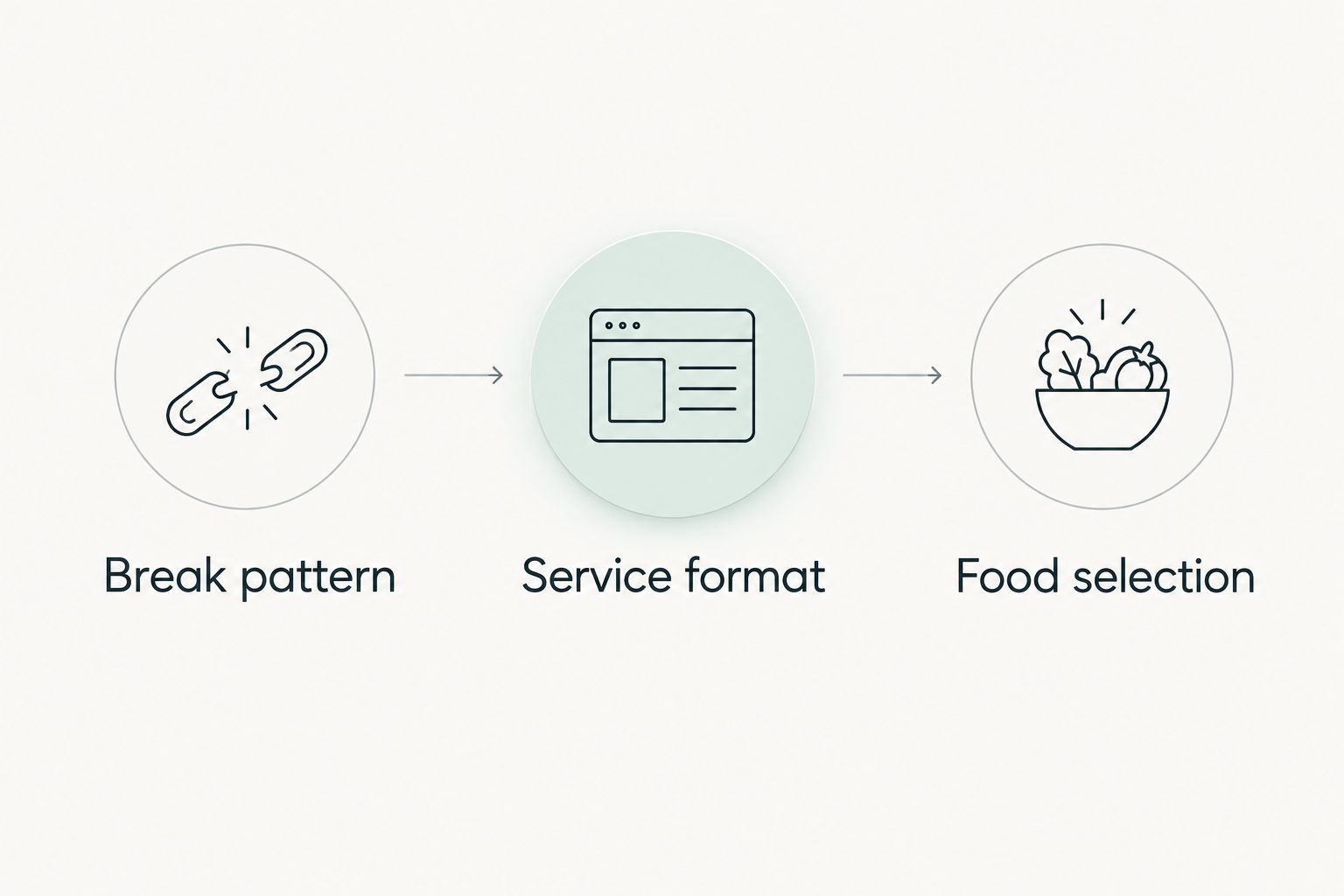
The decision follows a simple sequence: break pattern, service format, then food selection. Reversing that order leaves you trying to fit an attractive menu into an unsuitable setup.
Match the food to the serving conditions
Begin with practical questions: can workers eat seated, is cutlery available, and can the site hold food at an appropriate temperature? A breakfast that needs assembly or careful plating requires a different setup from food distributed in individual portions.
Bagels and pastries are relevant starting points because they are among the café's stated offerings, but fillings, toppings, and accompaniments change storage requirements. Do not classify an entire breakfast as shelf-stable because one component is bread. Ask about the complete meal.
For a 2026 planning brief, describe the service conditions before asking for suggestions. That gives the caterer useful constraints without prescribing an item the business has not offered.
Check the proposed food against these conditions:
- Identify items that need refrigeration or hot holding.
- Confirm whether workers need plates or cutlery.
- Ask how components are packed and labeled.
- Keep allergen information with the corresponding food.
- Specify any beverage requirements separately.
- Confirm whether dietary substitutions are possible.
Set the handoff and food-safety plan
Write the access instructions yourself first. A site name alone does not identify the correct gate, receiving point, or person permitted to accept food. If outside drivers cannot enter, arrange an authorized handoff and confirm how the order will reach the eating area.
A catering order needs a food-holding plan, not just an arrival time. USDA consumer food-safety guidance advises keeping cold perishable food at 40°F or below and hot food at 140°F or above. It also advises against leaving perishable food unrefrigerated for more than 2 hours, reduced to 1 hour when the surrounding temperature exceeds 90°F.
These are handling limits, not suggested serving windows. Follow the caterer's food-specific instructions and any applicable workplace requirements; do not assume a shaded table or closed packaging provides temperature control.
Document the handoff with these instructions:
- Give the approved gate and receiving location.
- Provide a reachable site contact.
- Confirm pickup or delivery arrangements directly.
- Assign responsibility for temperature-controlled holding.
- Record when perishable food leaves temperature control.
- Specify what happens if the handoff is delayed.
Confirm the order and assign cleanup
Use a written order summary that both the organizer and caterer can check. Include the food, confirmed servings, dietary portions, service format, handoff details, and responsibilities. A message that says only breakfast for the crew leaves too much unresolved.
Ask the caterer to restate what is included. Transportation, setup, serving equipment, and waste removal are separate responsibilities unless the agreement explicitly includes them. For Bondstreetcafe breakfast catering, confirm those arrangements directly rather than inferring them from the restaurant's general catering offering.
Close the 2026 planning checklist with ownership, not another menu choice:
- Obtain written confirmation of the selected food.
- Reconcile confirmed servings with the attendee count.
- Verify the date, arrival window, and contact details.
- Assign someone to distribute reserved meals.
- Arrange bins and remove packaging from work areas.
- Decide who handles leftovers and returned equipment.
Compare breakfast options for your crew
Best for staggered breaks: individually portioned breakfasts. Best for a shared break: trays served from an organized eating area. These are service-format recommendations, not claims that a particular caterer supplies every option.
Use this comparison to define your request. Ask the caterer which formats it can provide, then confirm the exact contents and handling instructions. No format eliminates the need for a verified headcount or an assigned receiver.
| Option | Best for | Practical advantage | Key limitation |
|---|---|---|---|
| Individually portioned breakfasts | Crews taking staggered breaks | Separates servings for distribution | Adds packaging waste and still requires appropriate holding |
| Shared breakfast trays | Crews eating during a common break | Supports one organized serving point | Requires space, utensils, and shared-service oversight |
| Bagel-focused breakfast | Organizers seeking a simple bread-based format | Makes the main food format easy to specify | Fillings and accompaniments require separate dietary and storage checks |
| Pastry-focused breakfast | A light breakfast or meeting accompaniment | Keeps the main selection straightforward | Does not establish a complete meal for every attendee |
| Mixed breakfast selection | Crews with different preferences | Allows different food choices within one order | Requires clear portions and distribution rules |
For a local café conversation, Bondstreetcafe offers a relevant starting point through its breakfast and catering services. The limitation is specific: its stated offerings do not establish construction-site delivery, individual packaging, serving equipment, or a particular catering menu. Ask before building those features into your plan.
Common mistakes construction crew organizers make
Ordering against total project staffing
Total staffing includes people who might not attend breakfast. Use confirmed participation for the actual shift and ask crew leads to update changes through one organizer. This keeps the food count connected to the meal rather than the project roster.
Treating arrival as permission to enter
A confirmed arrival window does not authorize a driver to access the jobsite. Get the receiving location approved and give the caterer instructions that reflect site rules. Keep the handoff out of active vehicle routes and other restricted areas.
Assuming a bagel or pastry order needs no holding plan
The complete order determines handling requirements, including fillings, dairy accompaniments, and other perishable components. Ask for item-specific guidance instead of relying on the name of the main food. A bread-based breakfast can still include food that needs refrigeration.
Leaving dietary meals on the shared table
A labeled portion can still be taken by someone else if distribution is unmanaged. Assign a person to hand out reserved meals and keep the caterer's ingredient information available. Do not promise allergen-free preparation unless the caterer explicitly confirms the relevant precautions.
Forgetting the end of the meal
Breakfast is not finished when the food arrives. Assign responsibility for packaging, spills, serving equipment, and leftovers before service begins. Otherwise, the crew inherits an unplanned cleanup task when the break ends.
FAQ
What's the best breakfast catering format for a construction crew?
Individually portioned breakfasts suit staggered breaks, while shared trays suit a common break with an organized serving area. Choose the format around the work schedule, then confirm which options the caterer provides.
Does Bondstreetcafe offer construction crew breakfast catering?
Bondstreetcafe offers breakfast and catering in Boynton Beach. Contact the café to confirm whether its current catering selection, quantities, and handoff arrangements fit your construction crew's requirements.
How much breakfast should I order for my crew?
Base the order on confirmed breakfast attendees and the caterer's stated servings for each item. Separate dietary portions from the general assortment and agree on how late headcount changes will be handled.
Are bagels and pastries enough for a crew breakfast?
Bagels and pastries can form part of a crew breakfast, but the full meal should reflect attendee preferences and dietary requirements. Confirm accompaniments, portions, and storage instructions rather than assuming a mixed assortment suits everyone.
Can a caterer deliver breakfast directly onto a construction site?
Direct jobsite delivery requires agreement from both the caterer and the site's authorized contact. Confirm access rules, the receiving point, and the person accepting the order; do not assume delivery or site entry is included.
How do I keep catered breakfast safe during staggered breaks?
Keep perishable food under appropriate temperature control until it is served. USDA consumer guidance specifies cold holding at 40°F or below and hot holding at 140°F or above; follow food-specific instructions and track time outside temperature control.
What should a construction breakfast catering request include?
Include the date, confirmed headcount, break pattern, dietary requirements, serving format, and approved handoff location. Name the site contact and clarify responsibility for transportation, holding equipment, setup, and cleanup.
One last thing
Plan for the last worker to eat, not just the first. A breakfast that works at the initial handoff can fail later if reserved meals disappear or perishable food sits without temperature control.
Before approving your next 2026 crew breakfast, ask one final question: who owns the food between arrival and the last break? Put that person's name on the order brief. That single assignment connects receiving, distribution, holding, and cleanup.